
Get Your Career Unstuck: Career Diamond Model
There comes a point in many careers where something just doesn't feel right.
You might not hate your job. You might even be successful by most measures. But somewhere between the deadlines, responsibilities, family commitments and endless busyness, you've started asking yourself a quiet question:
Is this still what I want?
If you're a mid-career professional, you're not alone. Many people reach a stage where experience collides with uncertainty. You've lived through restructures, difficult managers, economic downturns, burnout and career disappointments. You know enough to understand the risks of change.
And that's often why you feel stuck. Not because you're lazy. Not because you're unmotivated. Because your brain is trying to protect you. At this stage of life, uncertainty feels expensive. Every career decision carries weight. There are mortgages, children, partners, ageing parents and financial commitments. The stakes feel higher than they did in your twenties.
Questions start to swirl:
-What if I retrain and fail?
-What if I stay and become obsolete?
-What if AI changes my industry completely?
-What if I've already missed my chance?
Most people assume career transitions stall because people lack motivation. In reality, many professionals are overwhelmed, exhausted and quietly terrified of making the wrong move. That's why I often return to a framework called the Career Diamond Model, developed by Andersen and Vandehey. What makes it powerful is that it doesn't simply tell you to take action. It helps you understand where you're stuck in the decision-making process so you can start moving forward with confidence.
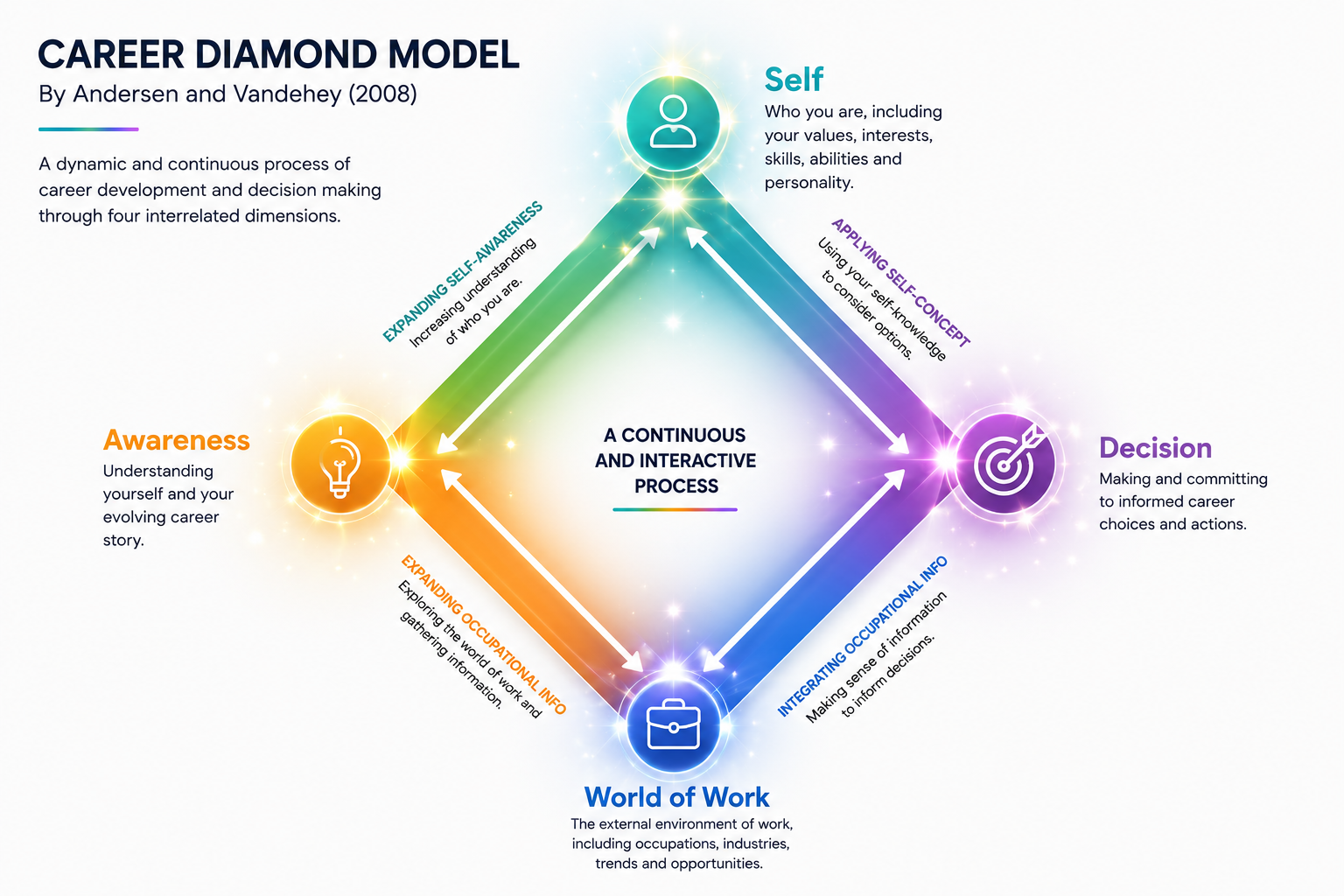
Step 1: Awareness – Listening to the Discomfort
Career transitions rarely begin with clarity. They begin with discomfort.
You might notice a sense of dread on Sunday afternoons. Perhaps holidays no longer leave you feeling refreshed. Maybe you're bored, restless, or endlessly scrolling job boards without knowing why. For many people, this is the first signal that something needs attention.
The challenge is that awareness sounds simple until you realise how disconnected many professionals have become from themselves.
You've spent years prioritising everyone else. Your team. Your family. Your clients. Your organisation. Somewhere along the way, you stopped checking whether your work still fits who you've become. Discomfort is an early warning system gently asking you to pay attention.
Many people try to skip this stage and jump straight into action.
"I need a new job."
"I should start a business."
"Maybe I need another qualification."
But sometimes the issue isn't your entire career. Sometimes it's burnout, poor leadership, values mismatch. Sometimes you've simply outgrown a version of yourself.
Awareness isn't about finding immediate answers. It's about asking better questions.
-What parts of my work energise me?
-What parts drain me?
-Am I burnt out, or am I misaligned?
-Am I afraid of change—or afraid of staying the same?
Step 2: Understanding Yourself
At the top of the Career Diamond sits one of the most important questions:
Who are you?
-Not your title.
-Not your salary.
-Not your LinkedIn headline.
-You.
This is often where career transitions become emotional. Many successful professionals built careers around competence rather than alignment. You became the dependable one. The expert. The high performer. The manager.You followed opportunities. You delivered results. But one day you arrive at the destination you worked so hard to reach and realise it no longer feels like home.
The challenge is that your identity has become intertwined with your role. When the role stops fitting, it doesn't feel like a career problem. It feels personal. The truth is that people evolve. Your values change, priorities shift. Your definition of success matures.
What motivated you ten years ago may not motivate you today.
This stage is about reconnecting with yourself:
Your strengths.
Your values.
Your motivations.
The type of life you want your career to support.
Sometimes that process begins with a simple conversation. Ask people who know you well what strengths they see in you. Often others can remind us of qualities we've stopped recognising in ourselves.
Step 3: Understanding the World of Work
Once you've developed a clearer understanding of yourself, it's time to turn outward. This is where reality enters the picture. And for many mid-career professionals, this stage feels confronting. You may not have applied for a job in ten years or understand the recruitment process or know what to do in a video interview. Your résumé is probably outdated, your interview skills are rusty. You hate those at the best of times. And the jobs market? You have no idea where to start.
At the same time, you're reading headlines about AI, automation, layoffs and changing industries. It's no wonder confidence takes a hit.
The purpose of this stage isn't to predict the future perfectly. It's to understand where opportunities are emerging and where your skills intersect with real-world demand.
In an age of AI, this matters more than ever. The professionals who thrive won't necessarily be those with the most technical expertise. They'll be the people who understand how their uniquely human strengths create value alongside technology.
Your experience and expertise still matters, the challenge is identifying where those capabilities are most valuable.
Step 4: Making the Decision
This is where many smart people freeze. Not because they lack options. Because they understand the consequences.
They stay in research mode:
-Another podcast.
-Another course.
-Another qualification.
-Another year.
It's a classic case of analysis paralysis. Underneath the overthinking is often a deeper fear: What if I can't trust myself to make the right decision?
The Career Diamond offers an important reframe. The goal is not to make the perfect lifelong decision. The goal is to make the next intelligent, informed and aligned step, taking what you understand about yourself and the world of work into a decision to step forward. Because clarity rarely arrives before action. Clarity is built through action. You test ideas. You gather feedback. You explore possibilities. You adjust course.
And then you take another decision, another step.
The Career Diamond Is a Cycle, Not a Destination
One of the most powerful aspects of this framework is recognising that you'll move through these stages many times throughout your career.
Awareness.
Self-understanding.
Understanding the market.
Decision-making
Then start again. to repeat the diamond.
The future of work is changing rapidly. AI is accelerating change across industries and careers. The ability to adapt and change is critical for all professionals of any age. Most people believe confidence comes before action. In reality, confidence often comes from action. You don't need your entire future mapped out before you move.
You don't need a perfect five-year plan.You don't need certainty. You need enough self-awareness to understand where you are, enough curiosity to explore what's possible, and enough courage to take the next step. Because careers aren't built through perfect decisions. They're built through movement.
And if you're feeling stuck right now, movement, not certainty is what will help you find your way forward.
