
Weekly AI Career News: Is the AI Jobs Doomsday Cancelled?
A Pope, a Banker, a Comedian and Two AI Billionaires Wade into the Future of Work
A Pope. A banker. A comedian. Two CEOs. A former Australian Treasurer. And two AI billionaires who suddenly seem less certain about the AI jobs apocalypse.
If you're looking for a signal that the conversation about AI and jobs has entered a new phase, consider this: the Pope just dedicated a 42,000-word manifesto to artificial intelligence.
Welcome to another week in AI Career news on Career Jam’s The Riff.
The Contradiction at the Heart of the AI Economy
The headlines continue to send mixed messages.
In the United States, technology layoffs have surpassed 115,000 workers through May, already approaching the total for all of 2025. AI has been cited as a contributing factor in nearly 50,000 of those job cuts.
Companies including Meta, Amazon, Cloudflare, Upwork and Intuit have all linked workforce reductions to AI initiatives. Intuit alone announced 3,100 layoffs while increasing investment in partnerships with OpenAI and Anthropic. Yet despite the headlines, the broader economic picture remains surprisingly stable.
Research from Yale's Budget Lab found no significant increase in unemployment across occupations with high AI exposure since ChatGPT launched. The disruption is real, but it is not yet showing up as a widespread labour market crisis.
This tension sits at the centre of today's AI debate: we are seeing visible disruption without clear evidence of a full-scale jobs apocalypse.
The Skills Gap Is Already Here
While the employment impacts remain uncertain, the skills impacts are undeniable.
In Australia, LinkedIn reports that AI Engineering is the fastest-growing role, while AI literacy has become one of the most sought-after skills across industries.
Meanwhile, the newly released Hays Salary Guide revealed a striking statistic:
60% of employees are already using AI regularly at work.
Only 22% have received formal training.
The gap between adoption and capability is widening. Workers are already using AI. Many are simply learning as they go.
The Bigger Australian Problem: Scared and Staying Put
The AI conversation often focuses on technology. But Australia's challenge may be more human. Australian Bureau of Statistics data shows workforce mobility has been declining for decades. In 1999, almost one in five workers changed jobs in a year. By 2025, that figure had fallen to just 7.7%.
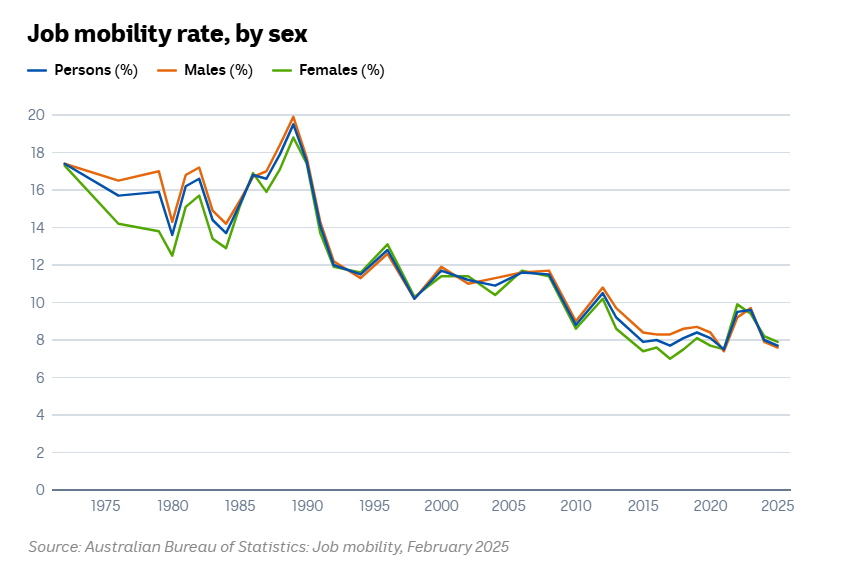
Australians are changing jobs less often, starting fewer businesses, and moving between states less frequently than previous generations. Whether it's rising living costs, the security of existing benefits, risk aversion or a more difficult labour market, many workers feel stuck. The challenge is that AI disruption is arriving in a workforce that is already struggling to adapt and move. Is Australia ready?
The Pope Enters the AI Debate
The most unexpected voice this week came from Pope Leo XIV.
In his first major encyclical, Magnifica Humanitas ("Magnificent Humanity"), he framed artificial intelligence not simply as a technology issue, but as a moral and social challenge.
Drawing parallels to Rerum Novarum, the landmark 1891 papal response to the Industrial Revolution, he argued that the pursuit of profit cannot justify systematically sacrificing jobs.
His central message was clear:
Technology must serve people, not the other way around.
The Pope is not anti-AI. He acknowledged its potential to drive breakthroughs in science and medicine. But he warned against creating societies where technological advancement benefits only a small portion of the population while leaving others economically sidelined.
Whether you're religious or not, it's difficult to ignore the significance of a global institution elevating AI from a technical discussion to a human one. It was also interesting that Anthropic co-founder was in the room. Are they really on the same side or is this PR positioning?
The Banker Who Said the Quiet Part Out Loud
Standard Chartered CEO Bill Winters sparked global backlash this week after announcing plans to reduce support staff by more than 50% by 2030.
The controversy wasn't the layoffs. It was the language. Referring to AI-driven workforce changes, Winters described some employees as "lower value human capital."
The reaction was immediate and global.
Former Singapore President Halimah Yacob called the comments ‘disturbing’ and ‘demeaning’. Social media erupted. Winters apologised within 24 hours.
Yet the episode revealed something deeper.
Many organisations describe AI-driven workforce changes using terms such as "reskilling," "redeployment" or "rightsizing."
The underlying reality often remains the same.
Winters didn't invent the concept. He simply failed to apply the corporate translation.
The Great AI Jobs Reversal
Perhaps the most fascinating shift this week came from two of AI's most prominent leaders.
For much of the past year, Anthropic CEO Dario Amodei warned that AI could eliminate up to 50% of entry-level white-collar jobs and push unemployment dramatically higher. Now his tone has changed.
This week he invoked Jevons Paradox, the economic principle that increased efficiency often drives increased demand rather than reduced activity. His new argument?
If AI automates 90% of a task, demand may expand so dramatically that entirely new forms of work emerge.
OpenAI CEO Sam Altman made a similar observation, admitting he expected AI to have already eliminated more entry-level jobs than it has.
The timing has raised eyebrows.
Both OpenAI and Anthropic are expected to pursue public offerings in the coming years, leading some observers to question whether the industry's rhetoric is evolving alongside investor expectations. Regardless of motive, the shift reflects a growing reality:
The evidence is currently pointing toward augmentation happening faster than mass replacement.
The Australian Voices Worth Listening To
Three Australian perspectives stood out this week.
Matt Comyn: No False Reassurance
Commonwealth Bank CEO Matt Comyn argued that pretending every job can be preserved is neither realistic nor fair. Instead, he called for organisations to help workers adapt while recognising that AI will reshape many roles. Importantly, he highlighted the capabilities likely to become more valuable:
Customer understanding
Risk judgement
Curiosity
Critical thinking
The ability to direct AI systems effectively
These are deeply human capabilities.
Joe Hockey, Former Australian Treasuer: The Warning Shot
Former Treasurer Joe Hockey delivered one of the week's boldest forecasts.
Speaking at the National Press Club, he warned Australia could face unemployment as high as 15% by 2030-31 if it fails to keep pace with technological change. While that figure sits at the extreme end of current projections, his broader concern was clear: Australia risks falling behind in adopting and preparing for AI-driven transformation. He said the way we are currently going we are sleep-walking into the future.
Ronny Chieng: The Actor/Comedian’s AI Pushback
The comedian, Daily Show correspondent an Crazy Rich Asians actor delivered perhaps the most memorable line of the week when he told Harvard graduates their mission was to "destroy AI."
His point wasn't literal. Use AI to advance science, medicine and discovery? Great. Use it to think for you? That's just dumb.
Chieng pointed to emerging research from MIT suggesting excessive reliance on AI can create "cognitive debt" by reducing opportunities to develop critical thinking and problem-solving skills.
His message resonated with a growing sentiment among younger workers who will live with the consequences of AI the longest.
The Research Tells a Different Story
This week's research reinforced a consistent theme.
The World Economic Forum's Future of Jobs Report found that 59% of workers will require reskilling by 2030.
Interestingly, seven of the ten fastest-growing skills are distinctly human:
Creative thinking
Analytical thinking
Curiosity
Resilience
Flexibility
Lifelong learning
Technological literacy
At the same time, AI capabilities continue advancing rapidly and can demand higher salaries.
A Harvard-led study found OpenAI's O1 model outperformed physicians when diagnosing complex emergency room cases using real patient records.
The technology is improving. But so far, the strongest evidence suggests the greatest challenge isn't mass unemployment. It's adaptation.
The Real Risk Isn't AI. It's Standing Still.
The most important takeaway from this week isn't that AI is taking everyone's jobs. It isn't. Not yet.
The bigger issue is that many workers are already operating in a labour market characterised by low mobility, slow reskilling and growing uncertainty. The pipeline that develops future talent is under pressure.
AI skills are in demand, training is lagging. And even the people building the technology cannot agree on exactly what comes next.
The AI jobs apocalypse may not have arrived. But the AI adaptation challenge certainly has. The question isn't whether change is coming.
The question is whether you're preparing for it or it will catch you by surprise.
